Or see where your firm stands first— the free AEC assessment takes about 8 minutes.
Your board is asking about AI. A technology committee is experimenting. Somebody bought Copilot seats. And nobody can say yet where the firm stands or what any of it is returning.
If that sounds familiar, you're in the majority: 85% of AEC firms say AI is important to their success, and only 36% apply it to project delivery (ACEC/BST Global, 2025). We work with firms in that gap: leadership agrees AI matters, and the project teams have not seen it in their work yet.
"We know enough to be dangerous" is the phrase we hear on almost every first call with a firm principal. It's usually accurate, and it's a fine place to start. The firms that get from dangerous to effective figure out where they stand, pick the first move, and put real systems behind it; the tools come after that sequence.
What we do for E&C firms
We run AI roadmaps, build workflow systems, and train teams for mid-market engineering and construction firms— design firms, general contractors, installation and field-services companies, and specialty contractors. Most of them are in the 100-to-500-person, $20M-to-$100M range that's too big to wing it and priced out of the Big Four.
The work lands where your hours go: proposals and RFPs, submittal reviews, RFI responses, scope narratives, daily field reports and punch lists, subcontractor coordination, meeting documentation, and the project knowledge buried in decades of closeout files. Among contractors who optimize their technology adoption, 77% report higher profit margins and 76% cut project delays by 5+ days (Dodge Construction Network, 1,100+ respondents)— and 92% of contractors already rate AI as effective for proposal generation (Dodge/CMiC, 2025).
We sit with mid-market firm leaders, build the workflows, train the team on the tools they already have, and measure what comes back. You keep everything we build.
First, see where your firm stands
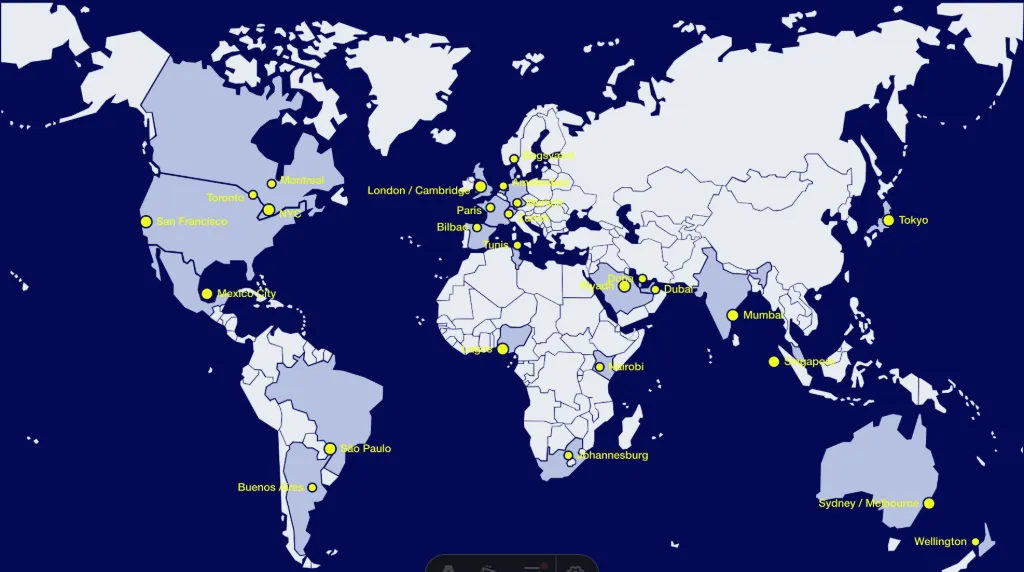
The count comes from published research on at least 401 named firms and organizations as of October 28, 2026. Some of that evidence is thin, and we have not yet validated the assessment method directly, so treat your result as a starting point for a conversation with your team.
In a full engagement, we interview your people and combine what they tell us with supporting evidence to score the firm. From that profile we propose one area to examine, agree on a test within a defined scope, and record the effort and the usable work before deciding whether to expand. Evidence and limitations.
There's an AEC edition of the assessment you can take right now. Twenty-five questions, about 8 minutes, results on screen, no email until the end.
Free · 8 min
See where your firm stands with AI
Twenty-five questions give you a reported profile across six dimensions and an area to examine with your team, in about 8 minutes. To see your result, you provide contact and firm details at the end and sign up for follow-up emails. Each email includes an unsubscribe link.
Start the assessment →Free assessment
Find out where you are with AI
In about 8 minutes, you can see your reported profile across six dimensions and a proposed experiment. To see your result, you provide contact and firm details at the end and sign up for follow-up emails. Each email includes an unsubscribe link.
Take the assessment →Free · 8 min
Where does your firm stand with AI?
In about 8 minutes, you can see your reported profile and an area to discuss with your team, shown on screen. To see your result, you provide contact and firm details at the end and sign up for follow-up emails. Each email includes an unsubscribe link.
See your score →What we did at a 250-person civil engineering firm
Keller Associates is a civil and water/wastewater engineering firm— 250 people across 12 offices in six states, employee-owned. Their board wanted an AI strategy that was more than a tool list. Over seven weeks we interviewed almost a third of the firm, scored where they stood, and delivered a prioritized roadmap their CEO presented at the all-shareholder meeting.
"They talked with almost a third of the firm before recommending anything, then handed us a clear, prioritized plan: what to do first, what to do later. He's not selling us software. The roadmap Dan has provided is what we needed to accelerate our AI journey."

Larry Rupp, PE
President & CEO, Keller Associates
"He raised our awareness of what's coming, pushed us to think hard about using AI responsibly, and worked with our team to build a practical roadmap for putting it to work."
James Bledsoe, PE
Board Chair, Keller Associates
Read the full story: how Keller Associates got its AI roadmap.
How we handle liability and client data
Engineering deliverables carry liability that most industries never think about. Our governance approach is built around that: AI does the work, and a licensed engineer still reviews and approves it— the same way you'd treat work from an EIT. We write that into your AI policy, along with the rules for client data, IP, and what's allowed anywhere near a submittal.
On data: we work inside your Microsoft environment (SharePoint, Teams, Azure) under NDA from day one. Your project files and client data never leave systems you control.
"The way Dan framed it has stuck with me: AI is like another EI (engineer-in-training)… a licensed engineer still reviews it and approves it… helped us get buy-in on using AI throughout the firm."

Eric Roundy, PE, BCEE
Senior Wastewater Engineer & Board Treasurer, Keller Associates
Who this is for
Principals and operations leaders at engineering firms, construction GCs, installation and field-services companies, and specialty contractors doing $20M-$100M, including firms building out warehouses and distribution centers. AEC-adjacent firms (sustainability, commissioning, construction management) with the same shape of work fit here too. If your firm is smaller than that, start with the free assessment: you'll get your reported profile across six dimensions and a proposed experiment to discuss with your team, no engagement required.
The best timing is before budget season, while next year's plan is still open. But the upside is real either way, and the timing is yours.
Questions
Do you know our industry?
We’re ACEC members. Our flagship engagement was a 250-person civil engineering firm, and the model behind our work was built on research into how AEC firms run. We know what an RFI is, what submittal review costs, how long a punch list takes to close out, and why "we can figure it out ourselves" is the real competitor. You can pressure-test us on a 30-minute call.
Our TI committee thinks we can handle this internally. Why bring in outside help?
You can figure it out. The question is how long it takes and what you miss along the way. We work alongside your committee. They get expert backup and extra bandwidth on a problem they’re already carrying on top of full-time jobs.
We already bought Copilot. Why isn’t that enough?
Copilot is a tool, and tools don’t implement themselves. The firms that see returns redesign the workflow first (the proposal process, the submittal review) and then point the tool at it, with training and a way to measure what comes back. That sequence is most of what we do.
What does an engagement cost?
We give you a number on the call once we know firm size and how many offices we would interview. The assessment and the Signal Call that follows it are free, and both are useful whether or not we ever work together.
How do you protect client and government project data?
We work inside your environment and never export your data. NDA from day one, and the AI policy we deliver covers exactly what’s allowed near client data, IP, and deliverables. For firms with government work, we design around your compliance requirements from the start.
See where your firm stands
Take the free AEC assessment and get your result on screen in about 8 minutes, or book a 30-minute call and we'll walk it together.