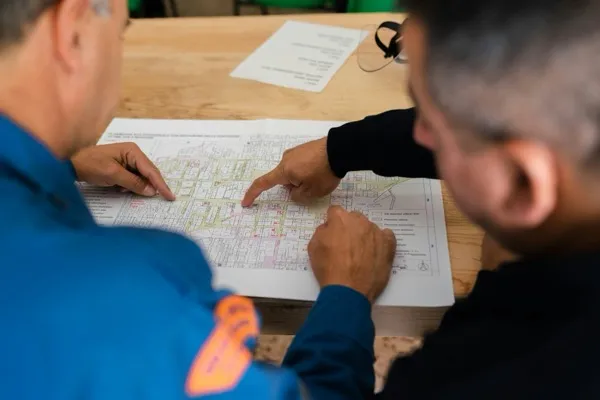

Your acquisition team has three sites on the short list. Each one needs a feasibility study. And the clock is already running on one of them.
That used to mean weeks of manual work— parcel research, zoning analysis, layout iteration, pro forma inputs. Autodesk decided that bottleneck was worth $240 million to address: in 2021, they acquired Spacemaker, an AI platform that simultaneously considers terrain, wind, lighting, traffic, and zoning constraints to generate site layouts1. That platform is now Autodesk Forma1.
AI in land development engineering now compresses feasibility studies from weeks to hours and site plan iteration from days to seconds. But these tools generate options, not decisions. The engineer's judgment remains where it always was: on the call.
This article covers four workflow areas where AI delivers real time advantage— early-stage feasibility, site plan generation, zoning analysis, and grading optimization— plus the adoption reality and a practical framework for evaluating which tools fit your firm's specific workflows.
Early-Stage Feasibility Analysis: From Weeks to Hours
Early-stage feasibility— the phase where teams determine whether a site is developable and at what yield— is where AI delivers its clearest time advantage. Studies that took days to weeks now complete in hours or less, depending on the platform and site complexity.
TestFit evaluates over 650 deals per week on its platform2. Not faster than one engineer on one site. But running simultaneously across a volume no team can match. TestFit's generative design enables AI to autonomously test site solutions based on project parameters— floor area ratio, parking ratios, yield on cost— and generate real-time insights covering design, cost, and constructability2.
Terra Zone AI describes replacing a $20,000 land feasibility study with a 60-second AI-powered analysis3. That's a vendor claim, and the 60-second figure reflects best-case conditions on a straightforward parcel with complete data. The directional shift is real; the exact number depends heavily on site complexity.
One industry analysis estimates that an AI platform integrated with land development workflows can achieve up to 65% time reduction, with professionals potentially saving 676 hours per year4. These are aggregate projections with directional value only— a calculator output rather than a measured result. The actual time savings depend heavily on your specific workflows and site complexity.
The Zenerate platform extends early-stage feasibility to include test fits, unit mix studies, parking layouts, design option generation, and pro forma analysis5. Combined, these platforms represent a purpose-built category targeting the single most expensive bottleneck in land acquisition.
| Platform | Primary Use Case | Speed Claim | Confidence Level |
|---|---|---|---|
| TestFit | Feasibility and deal volume at scale | 4x faster site planning2 | Medium (vendor-reported) |
| Terra Zone AI | Early-stage feasibility | 60-second analysis3 | Medium (vendor-reported) |
| Zenerate | Full early-stage workflow with pro forma | Not specified | Medium (vendor-reported) |
The feasibility phase handles viability. The next bottleneck— site plan iteration— is where AI's capacity to test thousands of layouts simultaneously becomes its defining advantage.
AI Site Planning: Evaluating Thousands of Layouts in Real-Time
AI site planning tools generate thousands of layout options simultaneously, testing each against zoning constraints, setbacks, parking ratios, and yield targets. The engineer's job shifts from drawing options to evaluating them.
Autodesk Forma— formerly Spacemaker— integrates geospatial analysis of terrain, wind, lighting, traffic, and zoning to evaluate site layouts against all variables at once1. The $240 million Autodesk spent acquiring this capability was specifically about owning the early-stage feasibility window. That's where the industry decided the value was.
Bentley Systems announced OpenSite+ in October 2024 as a generative AI application for civil site design— Bentley's own positioning describes it as the first native CAD-integrated civil site design application of its kind6. Bentley claims it delivers optimized site designs up to 10 times faster than traditional methods6. The AI layout agent evaluates thousands of layout options and suggests alternative designs in real-time— the work that previously required multiple full rounds of manual drafting6.
TestFit's Site Solver rounds out the category: it generates site plans instantly with real-time insights covering design, cost, and constructability metrics2.
| Platform | Key Capability | Speed Claim | Integration |
|---|---|---|---|
| Autodesk Forma | Geospatial + zoning + terrain analysis | Not specified | Civil 3D, AEC workflows |
| Bentley OpenSite+ | Generative layout evaluation, civil site design | 10x faster (Bentley-claimed)6 | Civil site design workflows |
| TestFit Site Solver | Feasibility + cost + constructability, real-time | Instantaneous generation2 | Standalone + API |
The 10x claim comes from Bentley's official announcement. The mechanism— AI evaluating thousands of layout options simultaneously— is independently verifiable and consistent across sources.
Layout iteration is where AI earns time. Zoning analysis is where it produces the most dramatic speedup in the entire land development workflow.
Zoning Analysis: The Most Dramatic Speedup
Zoning analysis— parsing municipal codes to determine what a parcel can accommodate— has historically taken days to weeks per site. AI tools now scan thousands of parcels against complex municipal codes in minutes, cutting permit review and entitlement (the regulatory approval process) analysis from weeks to days7.
In July 2026, Zoneomics launched Bassett.ai as an AI operating system that transforms municipal zoning and land use regulations into automated workflows for due diligence, entitlement, design, permitting, lending, and government7. The platform targets the entire entitlement workflow, not just code lookup.
Esri's EuclidHL offers a different entry point. It's a GIS-enabled AI planning and zoning assistant that answers community-specific questions in plain language, graphics, and maps8. Ask it what the maximum density a specific parcel supports, and you get a mapped answer. EuclidHL also integrates with ArcGIS Urban planning projects, enabling scenario analysis for urban development and zoning capacity8.
Two platforms worth knowing:
- Zoneomics Bassett.ai— AI operating system for full zoning intelligence workflows; launched July 20267
- Esri EuclidHL— GIS-enabled zoning assistant for community-specific questions and ArcGIS Urban integration8
One critical qualification: AI can tell you what the municipal code allows. It cannot tell you what the planning commission will approve, how community opposition will factor in, or how a variance request will be received. The political and discretionary elements of entitlement remain firmly human territory.
Feasibility, layout, and zoning cover the early-stage workflow. A fourth area— grading and infrastructure— is emerging more slowly but holds real capability.
Grading Design AI: Real Capability, Thinner Verification Record
AI is beginning to address grading design and utility coordination— areas where calculation complexity is high and margin for error is low. These capabilities exist and are improving, but the verification record is thinner than feasibility or zoning tools.
AI grading optimization balances multiple constraints simultaneously: positive drainage away from the building, ADA slope requirements for accessible routes, minimizing earthwork quantities through cut-fill balance, and satisfying stormwater detention volume requirements9. That's the kind of multi-constraint optimization that takes civil engineers significant calculation time to work through manually.
Three emerging capabilities:
- Civil 3D AI— Autodesk's Civil 3D now includes AI-assisted capabilities: conversational guidance for script generation and low-code automation via Dynamo10
- ArcGIS for large-scale development— Esri reports AI and ArcGIS are now used to prepare data for AI model runs and visualize design outputs for digital twins in large-scale land development projects11
- Grading constraint optimization— AI generates grading plans satisfying drainage, ADA, cut-fill, and stormwater requirements simultaneously9
For mid-market AEC firms managing grading-intensive sites across multiple simultaneous acquisitions, AI-assisted grading optimization is the capability worth tracking— even if it's not the entry point for initial adoption.
The honest limitation: grading accuracy claims are largely vendor-originated. No independent third-party validation of AI cut-fill predictions against actual earthwork outcomes exists in the available research. Treat AI grading outputs as starting points requiring professional review— especially on sites with complex drainage or tight cut-fill tolerances.
Across all four of these workflow areas, a pattern holds: AI generates options and validates constraints. What it cannot do is make the calls that require a licensed professional. That line matters more in land development than almost anywhere.
Where Human Judgment Is Non-Delegable
AI cannot evaluate material feasibility, assess structural stability, make ethical or social trade-offs, or judge site-specific constraints like flooding hazards or soil conditions. These are not limitations that better data will fix— they are the definition of engineering judgment12.
Autodesk University states it plainly: human judgment is essential to evaluate, refine, and select AI suggestions appropriately, with engineers interpreting AI outputs to determine which design improvements are feasible and relevant to the site context12.
The framing that holds up best comes from Tata Consulting Engineers: the most effective model in AI-assisted engineering is collaborative— AI handles computation and data processing; humans provide judgment, validation, and innovation13.
"The most effective approach is a collaborative model where AI handles computation and data processing while humans provide judgment, validation and innovation."— Tata Consulting Engineers13
The engineer of record signs and seals the drawings. An AI platform generates a recommendation; the engineer makes the call. AI outputs are starting points, not conclusions— every AI-generated option requires professional validation before advancing in the design process.
An engineer's job is deciding which questions matter about a site. AI runs the calculations faster. The professional judgment about which answer is right for this specific site— this soil, this drainage pattern, this neighborhood, this entitlement environment— is not in the output. It never has been.
That's the intellectual augmentation frame— IA instead of AI. The tool handles iteration at scale so engineers can spend more time on the judgment that only a licensed professional can exercise.
The judgment question is settled. Where the industry stands is a different conversation.
Adoption Reality in AEC: Where Firms Actually Stand
Only 27% of AEC firms currently use artificial intelligence for automation, problem-solving, or decision-making14. AI in land development engineering is early-stage adoption, not mainstream practice. That's worth saying plainly: most firms aren't doing this yet.
The trajectory is steep, though. 94% of current AI users planned to increase adoption during 202614. Firms that got in early are doubling down.
The barriers holding the other 73% back aren't cost. According to the Bluebeam AEC Technology Outlook 2026, the primary adoption barriers are14:
- Complexity— integrating AI tools into existing CAD/GIS stacks and workflows
- Culture— building team buy-in and working through change resistance
- Connection— getting AI outputs to communicate with the tools engineers already use
This reframe matters. The budget question is largely resolved. The challenge is building an AI-ready culture and getting the integration right the first time.
Land development AI is crossing the chasm— early-adopter territory, where the question isn't whether to use it eventually, but whether to be one of the firms that figures out integration before regional competitors do. When you're evaluating acquisition targets, being able to assess 3x more sites with the same team is a durable edge.
Building an AI strategy now, before that window closes, is the move most early-mover AEC firms are making.
The adoption decision comes down to your firm's workflows, not industry trends. That's where the practical question lives.
How Mid-Market AEC Firms Should Think About This
The right starting question for any AEC firm: where is early-stage feasibility or site plan iteration slowing you down? That workflow gap is the entry point, not a vendor demo.
A practical evaluation framework:
- Identify your actual bottleneck first— Feasibility speed? Zoning research time? Layout iteration volume? The answer shapes which tool category you need, not vice versa.
- Assess your integration requirements— The primary adoption cost is integrating with your existing CAD/GIS stack— budget for team time and workflow disruption alongside the license fee. What integration costs in practice is under-documented in available research; plan for it anyway. Our overview of the hidden costs of AI projects covers a framework for budgeting this honestly.
- Build validation into the workflow from day one— AI outputs require professional review. That step belongs inside the process, not at the end as a final check. Factor engineer review time into your ROI calculation before committing.
The firms that get value from land development AI fastest identify a specific pain before shopping for a solution. Find the bottleneck first. Then find the tool.
If mapping AI tools to your firm's specific workflows feels like a significant lift on its own— that's exactly where an implementation partner earns their place. AI implementation services for AEC firms start with understanding your current workflow before recommending anything. An AI decision framework can help map the right solution to your stack before you commit capital.
FAQ
Can AI replace civil engineers in land development?
No. AI generates layout options, runs constraint analysis, and accelerates feasibility calculations. What it cannot do is evaluate material feasibility, assess structural stability, make ethical or social trade-offs, or judge site-specific constraints like flooding hazards or soil conditions12. These are not gaps that improved software will close— they're what engineering judgment actually is. The engineer of record still owns the call.
How much faster is AI site planning?
Depends on the task. Feasibility studies compress from days or weeks to hours; zoning analysis can drop from weeks to minutes for straightforward parcels with complete data; site layout iteration is reported at 4x–10x faster by leading platforms26. These are vendor speed claims. Verify them against your specific site complexity before building them into a business case.
Which AI tools are used in land development engineering?
Market leaders include Autodesk Forma (formerly Spacemaker), Bentley OpenSite+, TestFit, Esri ArcGIS with EuclidHL, and Zoneomics Bassett.ai16287. Choice depends on which workflow you're targeting— early-stage feasibility, layout iteration, or zoning analysis— and how each platform integrates with your existing CAD/GIS stack.
What are the barriers to AI adoption in AEC firms?
The Bluebeam AEC Technology Outlook 2026 identifies complexity, culture, and connection as the primary barriers— not cost14. The challenge is integrating AI into existing workflows and building team buy-in, not affording the software license. That framing changes how firms should plan their adoption approach.
Does AI help with zoning analysis?
Yes— zoning analysis is where AI produces its most dramatic speedup. Tools like Zoneomics Bassett.ai and Esri's EuclidHL parse municipal codes and apply them to parcels at scale, cutting analysis from weeks to minutes78. What AI cannot do is predict what the planning commission will approve, how a variance request will be received, or how community opposition will factor in. The political and discretionary elements of entitlement remain human judgment calls.
Conclusion
AI in land development engineering is a real shift— one that compresses the most time-expensive early-stage work without changing who is responsible for the professional calls.
The firms building compounding advantage right now are early adopters— the ones integrating AI into feasibility, zoning, and site planning workflows before their regional competitors figure out the integration. At 27% adoption14, that window is still open.
The line that holds is the one the headline names. Professional liability, site-specific risk assessment, material feasibility judgment, and ethical trade-offs stay with the engineer of record. AI handles iteration at scale; the licensed professional handles everything else.
That's the intellectual augmentation frame: the tool handles the calculations so engineers can spend more time on the judgment that only a licensed professional can exercise. Your acquisition team gets to evaluate more sites. The calls still belong to the engineer. Both of those things are true at once, and that's the point.
References
- Autodesk / NASDAQ, "Why Autodesk Spent $240 Million on This AI Platform for Early Stage Real Estate" (2021)— https://www.nasdaq.com/articles/why-autodesk-spent-$240-million-on-this-ai-platform-for-early-stage-real-estate
- TestFit, "TestFit Launches Groundbreaking Generative Design for Better Building Optimization" (2024)— https://www.testfit.io/news/testfit-launches-groundbreaking-generative-design-for-better-building-optimization
- Terra Zone AI / Converge, "Terra Zone AI— The $20,000 Question That Now Takes 60 Seconds" (2026)— https://blog.enter.converge.ai/blog/terra-zone-ai-the-dollar20000-question-that-now-takes-60-seconds
- LotWorks, "Land Development ROI Analysis" (2026)— https://www.lotworks.ca/roi-calculator
- Zenerate, "Zenerate and Pivotal Architecture Join Forces to Accelerate Early-Stage Real Estate Development Planning" (2026)— https://thecitymaker.com.my/zenerate-and-pivotal-architecture-join-forces-to-accelerate-early-stage-real-estate-development-planning/
- Bentley Systems, "Bentley Systems Announces Generative AI Game-Changer for Civil Site Design" (2024)— https://www.businesswire.com/news/home/20241009012509/en/Bentley-Systems-Announces-Generative-AI-Game-Changer-for-Civil-Site-Design
- Zoneomics, "Zoneomics Launches Bassett.ai, the AI Operating System for Zoning Intelligence" (2026)— https://www.businesswire.com/news/home/20260730213296/en/Zoneomics-Launches-Bassett.ai-the-AI-Operating-System-for-Zoning-Intelligence
- Esri, "GIS-Based Large Language Model Answers City Planning Questions" (2025)— https://www.esri.com/about/newsroom/arcnews/gis-based-large-language-model-answers-city-planning-questions
- Nomic AI Glossary, "AI for Site Civil Design" (2026)— https://www.nomic.ai/glossary/ai-for-site-civil-design
- Autodesk, "The Future of CAD Management: How AI Is Transforming AutoCAD and Civil 3D 2025" (2025)— https://www.autodesk.com/autodesk-university/de/class/The-Future-of-CAD-Management-How-AI-Is-Transforming-AutoCAD-and-Civil-3D-2025
- Esri, "AI and ArcGIS Help Automate Design for Large-Scale Developments" (2025)— https://www.esri.com/about/newsroom/arcnews/ai-and-arcgis-help-automate-design-for-large-scale-developments
- Autodesk University, "The Importance of Human Judgment in AI-Driven Design" (2025)— https://www.autodesk.com/autodesk-university/article/the-importance-of-human-judgment-in-ai-driven-design
- Tata Consulting Engineers, "Why Engineering Still Needs Human Judgment" (2025)— https://www.tataconsultingengineers.com/blogs/why-engineering-still-needs-human-judgment/
- Bluebeam / BST Global, "AEC Technology Outlook 2026: How AEC Firms Are Building Smarter" (2026)— https://bluebeam.com/resources/ebooks/aec-tech-outlook-2026/