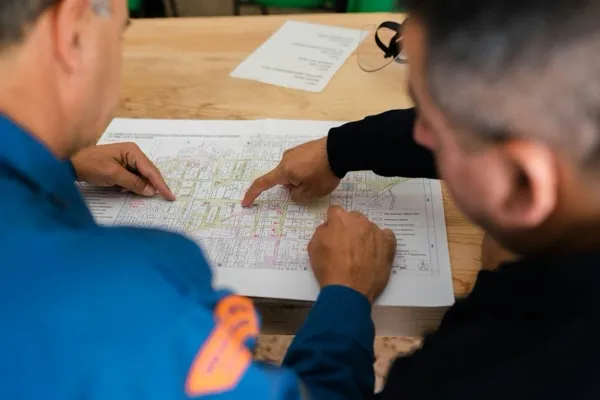

You're holding two daily reports from the same job site, the same Tuesday in October.
The first reads: "Light rain. Crew on site. Good progress."
The second logs temperature at 48°F at 7 a.m. and 52°F at noon, documents fourteen concrete workers and three machine operators idle from 8:15 a.m. to 11:45 a.m. due to precipitation above pour threshold, identifies the affected sequence, and carries the delay to Thursday's schedule.
What a good daily report construction sample shows you is this: those two entries represent the same day's reality, and only one of them would hold up in a dispute. A completed daily construction report is a diagnostic tool— not just a record of what happened, but a test of whether you could prove it. Fieldwire, which manages 4,000,000+ projects on its platform, is direct about the stakes: poor daily logging practices are a hidden risk, and missed details can cost millions in claims1.
A complete report covers eight primary sections3: general information, work activities, materials and equipment, inspections, safety, budget impact, review and sign-off, and action plan. But what a good sample reveals goes deeper than field names. Here are the five specific things a quality report shows— and a weak one hides.
#1— Whether the Project Is Actually on Schedule (Not Just "Making Good Progress")
A good daily construction report sample shows you real schedule status by logging measurable completed work against planned activities— not progress sentiment. "Concrete poured: 40 cubic yards of 60 planned. Remaining 20 cubic yards rescheduled to Thursday per superintendent's direction" tells you something. "Good progress on pour" tells you nothing. If the entry doesn't give you a number, it doesn't give you anything.
According to Procore3, "companies can gauge project progress by continually analyzing daily reports to determine whether they are ahead or behind schedule." That analysis only works when entries give you something measurable to analyze. Struxhub identifies three critical project health indicators that a superintendent daily report reveals: schedule adherence, resource efficiency, and risk exposure4. All three require specific quantities and named activities.
| Weak Entry | Defensible Entry |
|---|---|
| "Good progress on concrete pour" | "Concrete poured: 40 of 60 CY planned. 20 CY deferred to Thursday per superintendent's direction." |
| "Framing work ongoing" | "Framing crew (8 workers, 6 hrs each) completed east wing exterior wall panels 3–7. Remaining: panels 8–12." |
CMiC Global is direct: "vague entries hold minimal value in disputes or audits"2. That applies first to schedule documentation. A construction progress report that reads "work progressing" tells the PM, the owner, and ultimately a mediator exactly nothing about where the project stands.
Schedule status answers 'what happened.' The workforce section answers 'who was responsible.'
#2— Who Was Accountable for What, on Which Day
A good daily construction report sample shows you exactly who was on site, what they were doing, and how many hours they worked— by name and trade, not just headcount. That specificity is the difference between being able to prove accountability and being unable to. It's not a paperwork preference. It's what holds up when the question gets asked six months from now.
Raken defines complete workforce documentation as covering "who was on-site, what they did, hours worked, what equipment or materials they used, and how much progress was made"7. Site superintendents and site supervisors are primarily responsible for this documentation; project managers typically review and may sign off. The report should be completed same-day.
A complete workforce entry includes:
- Headcount by trade— concrete sub: 8 workers; mechanical sub: 3 workers; GC self-perform: 5 laborers
- Named individuals at foreman level minimum— arrival and departure times by crew lead
- Assigned tasks in measurable terms— not "mechanical work" but "HVAC ductwork, floor 3 east wing, 40 linear feet completed"
- Labor deployment against plan— whether the crew executed as scheduled or was redirected
CMiC Global is specific about why this matters: "measurable language and named individuals make logs defensible during claims or insurance reviews"2. Aggregate headcount ("12 workers on site") fails to show which trade did which work, who directed what, or whether labor was deployed as planned. When accountability is contested six months later, the unnamed-workers report is the one that can't answer those questions.
Named workers establish who was there. The delay section establishes what stopped them— and who caused it.
#3— Where Delays Came From and Who Owns Them
A good daily construction report sample shows you not just that a delay happened, but its cause, duration, affected scope, responsible party, and critical path impact. Weather is the most commonly cited factor in construction delay claims— and the most commonly under-documented2. Generic entries like "cloudy" or "light rain" carry minimal weight when the claim hits6.
What complete weather documentation includes:
- Temperature at AM and PM (conditions shift mid-day)
- Precipitation type and amount
- Wind speed, if affecting operations
- Crew-hours lost by trade— specific numbers, not impressions
- Whether the delay carries to the next workday
Projul makes a point that most teams miss: document weather conditions on good days too6. A log that only records adverse weather lacks the baseline that makes those adverse-weather entries credible. As Projul notes, "your daily reports form the backbone of any claim"6.
Mastt identifies the four elements most frequently omitted from daily reports: idle equipment, standing labor, verbal instructions, and the reason work stopped5. These are exactly the elements that matter most in claims. Mastt's standard for specificity: quantify as "fourteen people and three machines idle for three and a half hours" rather than "rain delayed the pour"5.
The first four are what most teams leave out entirely. The second four are the analytical layer that turns a log entry into a claim-ready record. Superior reports add four analytical judgments: delay categorization, responsibility assignment, critical path impact (the task sequence that determines project completion date), and notice compliance status5.
Firms using automated delay documentation workflows capture these details in real time. Without that discipline built in, it falls entirely to the superintendent at end of shift— and accuracy degrades with every hour of delay.
As Andrews Myers, P.C. (a construction law firm) puts it: "if it is not documented, it is difficult to prove"8.
Delays are acute events. Safety tells a different kind of story— one that only reads clearly over time.
#4— How Your Safety Culture Is Trending, Not Just Today's Incident
A good daily construction report sample shows you one day of safety. A series of good reports shows you whether your site safety culture is improving or deteriorating. That distinction is what separates reactive incident response from proactive safety management.
Complete daily safety documentation includes:
- Incidents and near-misses with specific descriptions
- Toolbox talk records— attendee names, topic, and time
- Hazard observations with location and corrective action noted
- Any OSHA-reportable events or notices issued
The diagnostic value comes from the series. Raken tracks "safety observations for month-over-month improvement tracking"7. A single day's toolbox talk record tells you a meeting happened. Twelve months of records across the construction daily log shows whether near-miss categories are increasing or clustering around a specific trade or phase. That's the pattern that drives proactive intervention— and it's only visible across a series, not within any single entry.
Struxhub puts it plainly: "clear and timely reporting becomes one of the most valuable tools in a superintendent's arsenal"4. And safety trend analysis is where that becomes most obvious. You can't see a pattern from inside a single day.
The fifth thing a good report sample shows you takes the longest to prove— and matters most when a dispute surfaces.
#5— Whether You Can Win a Dispute Six Months From Now
A good daily construction report sample shows you whether the record is the kind that wins disputes— or loses them. CMiC Global states it plainly: "courts and arbitration panels consistently give strong weight to records created at or near the time of the events they describe"2. A reconstructed report written six months later carries far less weight, no matter how accurate. Andrews Myers, P.C. confirms the same standard: successful construction claims rely on records created during execution, not reconstructed later8.
Three characteristics make a report series legally defensible:
- Contemporaneous creation— written same-day, not compiled from memory at week's end
- Specificity— measurable language, named individuals, quantified impacts
- Completeness— an unbroken daily series from mobilization through substantial completion
Strong documentation shifts the odds significantly in your favor. It doesn't guarantee any particular outcome— but it ensures your position can be argued from evidence rather than memory.
The Gap Problem is what you find when a sample report series has missing entries. CMiC Global identifies this directly: "gaps in the log timeline itself become evidence— opposing parties target missing documentation during disputes"2. A missing week doesn't read as a clerical oversight to opposing counsel. It reads as something that happened that the superintendent didn't want in the record.
Daily field reports establish when changes occurred, who knew about them, and how they affected downstream work8. The four types of records winning claims rely on are entitlement records, baseline documentation, causation evidence, and quantification data. All draw from a disciplined daily series.
Your contract terms and jurisdiction may affect specific documentation requirements. Consult legal counsel for project-specific guidance.
The principles in a good daily report sample apply whether you're logging by hand or using software— but the tools are changing what's possible.
How AI Tools Are Changing Daily Construction Reporting
The platforms have changed what's possible. Construction management software now automates weather logging, GPS-stamps workforce entries, and flags delays against the project schedule in real time. AI-powered tools don't replace the superintendent's judgment— they make it easier to document accurately while the day is still happening. In practical terms: the tool captures the what, the superintendent still decides the why.
Current capabilities in digital and AI-enabled platforms include:
- Automatic weather logging from location data— temperature, precipitation, and conditions captured without manual entry
- GPS-stamped workforce entries— arrival and departure times recorded as workers check in from the field
- Delay pattern flagging— enterprise platforms with analytics modules surface risk patterns by comparing current report data against project baselines and historical indicators
- Schedule integration— real-time comparison of logged work against planned activities
Fieldwire's research notes that completing reports from memory at end of day decreases accuracy1. The tool solves a behavior problem as much as a documentation one.
But the discipline matters more than the platform. Most firms reach for a better template when what they actually need is discipline about what specificity accomplishes— the form is the least of it. AI tools amplify good reporting discipline; they don't create it. A superintendent who doesn't understand why specificity matters won't get more out of digital software than out of a paper log.
If your firm is evaluating construction technology, AI implementation for construction operations benefits from someone who maps the right systems to your specific workflows. And measuring project technology outcomes is how you know whether those tools are actually delivering.
FAQ
What does a construction daily report sample show?
A completed sample shows five things: real schedule progress against planned activities, named workforce accountability, delay origins with quantified impact, safety culture trend data, and the legal defensibility of your project record. These elements answer questions that no other construction document addresses in one place. The form matters less than whether the entries contain specific, measurable information.
How specific should weather entries be in a daily construction report?
Record temperature, precipitation type and amount, and wind speed if it affects operations— with AM and PM conditions logged separately. Quantify the impact: which trades were affected, how many crew-hours were lost, and whether the delay carries to the next workday. Document good weather days too, so "Clear skies, 65°F, no weather impacts" entries establish the baseline that makes adverse-weather claims credible6. Generic entries like "cloudy" or "light rain" carry minimal weight in delay claims2.
Can a daily construction report be used in a lawsuit or arbitration?
Yes. Courts and arbitration panels consistently give strong weight to records created at or near the time of the events they describe2. A report written on the day of an event carries substantially more legal weight than a reconstructed account written months later5. The contemporaneous standard applies regardless of whether the report was completed on paper or through a digital platform.
What happens if daily reports have gaps?
Gaps in the log timeline become evidence. Opposing parties in disputes specifically target missing documentation to undermine credibility2. A complete, unbroken daily series is part of what makes a project record legally defensible— and a missing entry is not a neutral fact.
Who should fill out a construction daily report?
The site superintendent or site supervisor is primarily responsible. Project managers typically review and may sign off3. The report should be completed same-day— accuracy degrades when completed from memory at shift end, and end-of-day reconstruction defeats the contemporaneous record standard that courts recognize1.
The Same Thirty Seconds
Go back to those two reports from the opening. The defensible entry— temperature, idle count, affected sequence, carryover— took about thirty additional seconds to write. The entry that reads "light rain, good progress" took less.
The difference isn't effort. It's knowing what the specificity accomplishes. A project's daily report series is the only document that captures site conditions as they existed on a specific day. It either does that work, or it doesn't. Building a reporting discipline across site teams is where that understanding becomes consistent practice. That's the only way it protects you when you need it.
References
- Fieldwire (Hilti Company), "Construction Daily Report Best Practices & Examples" (2024)— https://www.fieldwire.com/blog/construction-daily-report-best-practices/
- CMiC Global, "What Every Construction Daily Log Should Include and Why It Matters" (2024)— https://cmicglobal.com/resources/article/What-Every-Construction-Daily-Log-Should-Include-and-Why-It-Matters
- Procore Technologies, "Construction Daily Reports: What to Include & Best Practices" (2024)— https://www.procore.com/library/construction-daily-reports
- Struxhub, "Superintendent's Guide to Effective Daily Reports: Top 10 Tips for Smarter Construction Project Management" (2024)— https://struxhub.com/blog/superintendents-best-guide-to-effective-daily-reports-top-10-tips-for-smarter-construction-project-management/
- Mastt, "Construction Daily Report Template (Word, Excel)" (2024)— https://www.mastt.com/resources/construction-daily-report-template
- Projul, "Construction Delay Claims: Document and Recover" (2024)— https://projul.com/blog/construction-delay-claims-guide/
- Raken, "How To Write a Construction Daily Report [with Example]" (2024)— https://www.rakenapp.com/blog/create-a-construction-daily-report-example
- Andrews Myers, P.C., "The 'Proof Is in the Paper': Day-One Documentation That Wins Construction Disputes" (2024)— https://www.andrewsmyers.com/blog/the-proof-is-in-the-paper-day-one-documentation-that-wins-construction-disputes/